
We Hold These Truths
The Declaration of Independence and The Greatest Edit of All Time

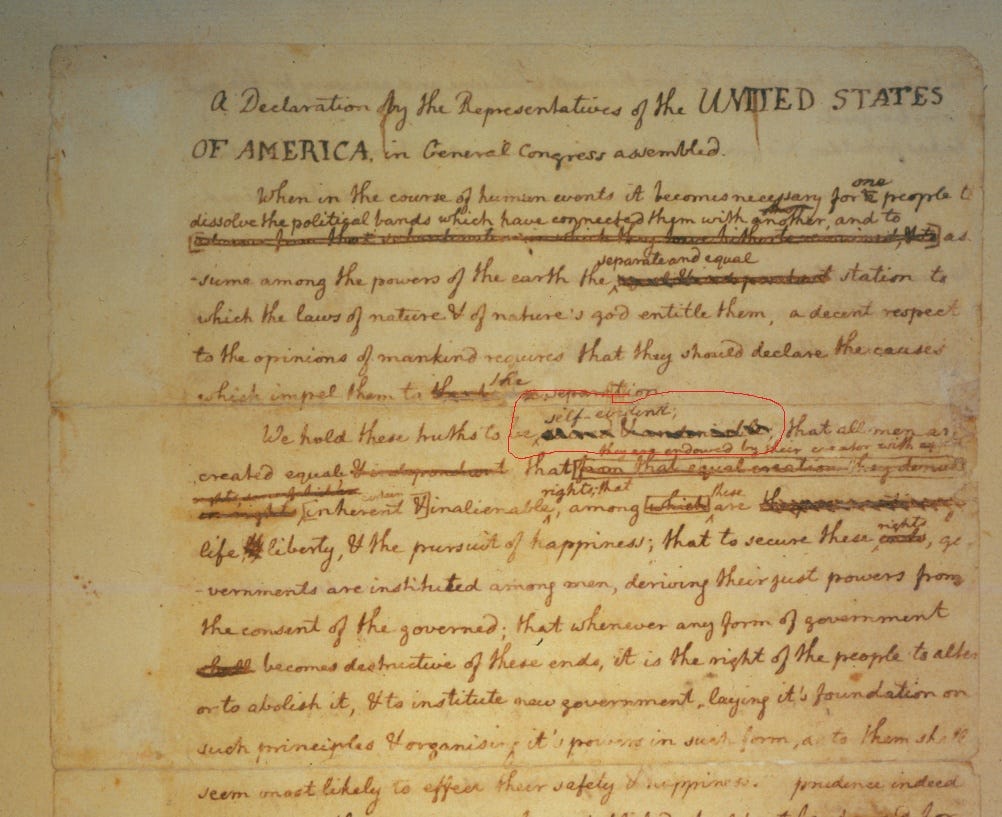
THE Declaration of Independence is located in the Rotunda for the Charters of Freedom at the National Archives in Washington, DC. It is a serious room with serious pillars, a high-domed ceiling and marble everywhere. America’s founding document is encased in glass, mounted in a gold frame and, after all these years, barely legible.
The document is credited to a lone man, but it was actually a group effort. No writer likes to be edited, and Thomas Jefferson was no exception. To make matters worse, he was edited by a committee: the fifty-six delegates to the Second Continental Congress. Each man had an opinion about what the document proclaiming American independence should and should not say and how it should or should not say it.
Jefferson bristled at these “mutilations” of his pristine words, sounding less like a founding father and more like a touchy writer. Not all of the edits were mutilations, though. Some improved Jefferson’s prose. One edit in particular changed the very nature of the declaration, and the new nation it birthed.
Jefferson’s original draft read: “We hold these truths to be sacred & undeniable; that all men are created equal.” An assertive pen stroke—most likely Benjamin Franklin’s—struck through “sacred & undeniable,” replacing it with “self-evident.” We hold these truths to be self-evident. The best-known seven words of the Declaration of Independence. It might seem like a minor revision, a more concise wording of the same idea, but it is more than that—much more. It is, I believe, the greatest edit of all time.
Jefferson’s original phrasing appealed to religious authority. These truths are sacred. They are undeniable, presumably because they are sacred. This was a fine seventeenth-century argument but not an enlightened eighteenth-century one, a time when appeals to sacred sources were on the decline. By revising the passage to read “self-evident,” Franklin invoked a different and, he believed, higher authority: human reason.
What is self-evident “strikes the mind as immediately and perpetually true” and “leaves no room for hesitation, doubt or examination,” wrote philosopher John Locke, the intellectual godfather of the American revolution. Self-evident truths are beyond—or, rather, above debate.
Here is the rub. Jefferson’s supposedly self-evident truths— “that all men are created equal, that they are endowed by their Creator with certain unalienable Rights, that among these are Life, Liberty and the pursuit of Happiness”— were not at all self-evident at the time. Jefferson and Franklin hoped that by proclaiming these truths as self-evident, they would become so. “We hold these truths to be self-evident” was less an observation than an assertion, a wish, one we have yet to fulfill.
Thankfully, though, Thomas Jefferson and his wise editor pointed us in the right direction. It is now up to us to get there.
Franklin's edit of 'sacred & undeniable' to 'self-evident' might be the most elegant pivot in American history. This is a beautiful read for the 4th.